Alot of people argue that Christmas is when it is because the date is close to a Pagan holy day. This however is not really correct. Yes there is some borrowing, but there are strong studies to show that December 25 was chosen for much more important reasons.
Christians celebrated 25 March as the Feast of the Annunciation, a commemoration which continues today. Since 25 December falls exactly nine months after the Annunciation, it seemed the most natural day on which to celebrate Jesus' birth. And teh date for the Annunciation was set first.
There may even be a strong basis for 25 December as the actual, historical date of Christ's nativity.
In a recent issue of "Osservatore Romano" (the Vatican's official newspaper), Professor Tommaso Federici, Professor at the Pontifical Urbanian University and consultant to two Vatican Congregations, says that recent archaological discoveries in the Holy Land shed light on when Jesus was born:
"As long ago as 1958, the Israeli scholar Shemaryahu Talmon published an in-depth study on the calendar of the Qumran sect, and he reconstructed without the shadow of doubt the order of the sacerdotal rota system for the temple of Jerusalem (1 Chronicles 24, 7-18) in New Testament times.
Here the family of Abijah, of which Zechariah was a descendant, father of John the herald and forerunner (Luke 1,5) was required to officiate twice a year, on the days 8-14 of the third month, and on the days 24-30 of the eighth month.
This latter period fell at about the end of September. It is not without reason that the Byzantine calendar celebrated 'John's conception' on September 23 and his birth nine months later, on June 24.
The 'six months' after the Annunciation established as a liturgical feast on March 25, comes three months before the forerunner's birth, prelude to the nine months in December: December 25 is a date of history"
Even the common argument that shepherds would not have been in the fields in December is inaccurate. That is the time of the year when sheep naturally begin giving birth ("lambing"), and the shepherds would typically stay with the sheep at night to take care of the newborn lambs. In fact, the lambing season would have been the only time of the year in which the shepherds would have stayed with the flocks during the night (see Luke 2:8).
So from what we know we would know when Zechariah was in the temple when he was told about John. We also know from the Visitation of Mary to Elizabeth and where they were in gestation where to place the rest of the dates.
This information seems to confirm that Jesus could well have been born on or near 25 December, perhaps even 6 January (considering the many possible normal fluctuations of gestational periods as human gestation is actually 10 months but varies). So either of these traditional dates may be - or at least come very close to - Jesus' real birthday!
The fact that December 25 happens to fall four days after the Winter Solstice is a coincidence of history (and the Eastern Christmas is sixteen days removed from the solstice, so it's harder to see a connection there).
Back to the Annunciation being set as a date first. Why do we celebrate the Annunciation on March 25 (aside from what Professor Federici has shown as common ancient knowledge about the birth of John)? Because the ancient Jews believed in something called Integral Lifespan. This is the belief that holy people die on the same day their life began. We know what date passover was the year Christ died, it comes out to March 25. Since life begins at conception, his life began (according to ancient logic) on March 25.
In the Didache, the recorded writings of the 12 apostles from the first century, it is clear that it was always believed by Christians that life begins at conception.
Now, I'm not saying that the integral lifespan theology is correct, but it was the basis for when to set the date. And yes traditions and such did develop from some pagan ways.
But look at the above...where three or four lines of thought and ancient proofs indicate that we actually have the right day. And it has nothing to do with pagan festivals.
Tuesday, December 04, 2007


Sunday, December 02, 2007
We are a People of Hope
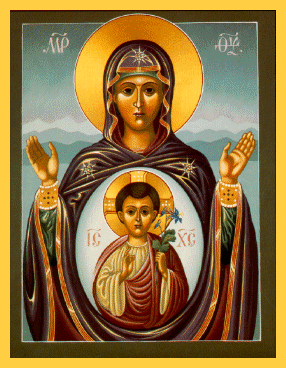
Pope Benedict's newest Encyclical letter (New Encyclical: For in this hope we were saved (Spe salvi facti sumus)), the second of his pontificate, explore the virtue of Hope. It is, in many ways, well timed for advent and the current state of our world. As I read through it I was continually struck with the realization as to how much hope is at the very heart of Christian living.
The pope writes:
Here too we see as a distinguishing mark of Christians the fact that they have a future: it is not that they know the details of what awaits them, but they know in general terms that their life will not end in emptiness. Only when the future is certain as a positive reality does it become possible to live the present as well. So now we can say: Christianity was not only “good news”—the communication of a hitherto unknown content. In our language we would say: the Christian message was not only “informative” but “performative”. That means: the Gospel is not merely a communication of things that can be known—it is one that makes things happen and is life-changing. The dark door of time, of the future, has been thrown open. The one who has hope lives differently; the one who hopes has been granted the gift of a new life.
Hope is the very heart of our faith. We are an Easter people. And what is being described above, if not the triumph over death and sin that is the hope of Easter. But we are also an Advent people…waiting and expecting the joy of Christmas. The arrival of the Savior.
But what the Pope writes about goes beyond that…he writes of an active hope. A hope that is, as he says, “performative”. In reality it is transformative…transfiguring. He says:
We have raised the question: can our encounter with the God who in Christ has shown us his face and opened his heart be for us too not just “informative” but “performative”—that is to say, can it change our lives, so that we know we are redeemed through the hope that it expresses?
But this hope…this living, performative, transformative and transfiguring hope is known by a name…a person. Drawing on St. Gregory Nazianzan the pope writes:
He says that at the very moment when the Magi, guided by the star, adored Christ the new king, astrology came to an end, because the stars were now moving in the orbit determined by Christ.2 This scene, in fact, overturns the world-view of that time, which in a different way has become fashionable once again today. It is not the elemental spirits of the universe, the laws of matter, which ultimately govern the world and mankind, but a personal God governs the stars, that is, the universe; it is not the laws of matter and of evolution that have the final say, but reason, will, love—a Person. And if we know this Person and he knows us, then truly the inexorable power of material elements no longer has the last word; we are not slaves of the universe and of its laws, we are free.
A person. As faith is an encounter with a Person. Christ. God. A Person who loves us beyond all human understanding. The cause of our Hope.
There is much more to the Pope’s new Encyclical and I have not finished it yet. But as we move toward Christmas and now into Advent…It is good to remember that we are:
An Easter People
An Advent People
A people of Hope
May we prepare our hearts.
Wednesday, November 28, 2007
Getting Back into the Swing of Things
I have not been reliable in blogging for a bit. I have spent some time moderating a Christian message board. I am now moderating a smaller one and will have more time. So after Christmas (hopefully through December) I will be blogging at least twice a week.
Monday, November 26, 2007
Shadia Nagui Ibrahim:
A summation of the story:
An Egyptian Christian woman has been jailed for three years because her father's brief conversion to Islam 45 years ago made her legally a Muslim while her official papers said she was Christian, her lawyer said Thursday.
The story is here at The Free Copts: link
Another source article: link
I hope to write more on this later.
An Egyptian Christian woman has been jailed for three years because her father's brief conversion to Islam 45 years ago made her legally a Muslim while her official papers said she was Christian, her lawyer said Thursday.
The story is here at The Free Copts: link
Another source article: link
I hope to write more on this later.
Wednesday, November 14, 2007
Tuesday, November 13, 2007
Egypt Arrests Three Christian Rights Activists
The Story: Link
A quote from the article:
The U.S. Copts Association said the recent arrest was likely caused by the men’s investigation into reports that a Coptic worker in Cairo was thrown from his balcony by two Egyptian police after he refused to pay them extortion money, according to WorldNetDaily.
The association’s report said soon after the Coptic worker’s fall, the Egyptian police had reported the death as suicide.
A quote from the article:
The U.S. Copts Association said the recent arrest was likely caused by the men’s investigation into reports that a Coptic worker in Cairo was thrown from his balcony by two Egyptian police after he refused to pay them extortion money, according to WorldNetDaily.
The association’s report said soon after the Coptic worker’s fall, the Egyptian police had reported the death as suicide.
Monday, November 12, 2007
Pope to make first visit to the United States
The Story is here (link)
Kind of odd to write that in a way. John Paul II traveled so very much that to think of this as the fist Papal visit is a bit odd. I'm looking forward to what he will say at the United Nations. I'm sure his visit to ground zero will be handled with dignity and will leave a lasting impression on more than a few American Catholics.
Kind of odd to write that in a way. John Paul II traveled so very much that to think of this as the fist Papal visit is a bit odd. I'm looking forward to what he will say at the United Nations. I'm sure his visit to ground zero will be handled with dignity and will leave a lasting impression on more than a few American Catholics.
Thursday, November 01, 2007
50 arrested in clash in Minya province
The Story:
Cairo (AP) -- Police arrested some 50 people Friday following a clash between Muslims and Coptic Christians triggered by a land dispute, security officials said.
Some 20 people were wounded during the clash in Minya province, some 210 Kilometers (130 miles) south of Cairo, the officials said, speaking on condition of anonymity because they were not authorized to speak to the media.
The clashes began after Friday prayers when Muslim villagers in Izbat el-Abid protested against the extension of a monastery in a nearby village, claiming the construction was on state property, the officials said.
Police had to ask for reinforcements from throughout Minya to control the clash, the officials added.
Cairo (AP) -- Police arrested some 50 people Friday following a clash between Muslims and Coptic Christians triggered by a land dispute, security officials said.
Some 20 people were wounded during the clash in Minya province, some 210 Kilometers (130 miles) south of Cairo, the officials said, speaking on condition of anonymity because they were not authorized to speak to the media.
The clashes began after Friday prayers when Muslim villagers in Izbat el-Abid protested against the extension of a monastery in a nearby village, claiming the construction was on state property, the officials said.
Police had to ask for reinforcements from throughout Minya to control the clash, the officials added.
Subscribe to:
Posts (Atom)