Why? You ask?
On 5 April, Fr George had just celebrated mass in a private house when seven religious policemen (muttawa) broke into the house together with two ordinary policemen. The police arrested the priest and another person.
ah..for worshiping in a private home.
A few years ago the Saudi government bowed to international pressure, and allowed the practice of other faiths in private, however this still leaves Christians in Saudi Arabia with little or no access to pastoral care.
Despite assurances, the muttawa still arrest, imprison and torture many who practice other faiths, even in the privacy of their own homes.
Below are links to the stories
(link)
(link)
Tuesday, April 11, 2006


A focus on Saints of the Coptic Orthodox Church after Easter

Those who read the blog know that after Easter I will be doing posts on the Saints of our brothers and sisters in the Coptic Orthodox Church. Oriental Orthodox, Eastern Orthodox and Roman Catholics share a great deal of early saints.
There are saints, however, that most of us in the west have never heard of before. There are also saints shared by both churches that most Catholics don't know about. For example, the Catholic Church considers St. Moses the Black and St. Mena to be saints. How many Catholic know their stories?
Over at Neferteeti's blog after Easter, she will be doing Some Catholic saints.
For my Coptic friends who read this blog, I'm going to post a list of saints I plan to post on. If you have any info or favorite stories about them, please email me through my profile or post a link in the comments.
Here is an early list:
St. Mark
St. Moses the Black
St. Sedhom Bishay
Simon the tanner
St. Mina
St. Demiana
St. Mary of Egypt
Saint Maurice and the Theban Legion
St. Barbara
St. Nicholas
If I have missed anyone who you think should be included, just let me know. I'm learning alot researching all of this, and hope that we can all grow closer to Christ through the stories of these holy men and women.
The image above is Saints Joachim and Anna, the grandparents of our Lord.
God or the Girl gets good reviews from Catholic sources
It seems that this show might find it's way past the sensational title and be an actual asset to understanding what these young men go through. Here is a link to the review (link).
I will also comment that I have head some good things from many people whom I trust, that this is not your normal reality TV fare. So, I will give the times of the show:
* Easter Sunday, April 16, 9-11 p.m. - Episodes 1 and 2
* Easter Monday, April 17, 9-11 p.m. - Episodes 3 and 4
* UPDATE: Friday, April 21, 7-11 p.m. - Marathon, Episodes 1-4
* Sunday, April 23, 10:00 p.m. -- FINALE
I will also comment that I have head some good things from many people whom I trust, that this is not your normal reality TV fare. So, I will give the times of the show:
* Easter Sunday, April 16, 9-11 p.m. - Episodes 1 and 2
* Easter Monday, April 17, 9-11 p.m. - Episodes 3 and 4
* UPDATE: Friday, April 21, 7-11 p.m. - Marathon, Episodes 1-4
* Sunday, April 23, 10:00 p.m. -- FINALE
Monday, April 10, 2006
God or the Girl? Rather: God or the Self

So A&E is going to air this new show God or the Girl. The premise is that the show will follow four young men who want to become Roman Catholic priests.
When I first hear about it, I was a bit wary. The choice to become a priest is something so big that the constant intrusion of cameras would add a very distracting element to the dynamic. My biggest problem is the title: God or the Girl.
This is one facet, agreed a large one, of the decision to become a priest. That a Catholic priest is celibate is not the only, and for many not even the largest factor in the decision.
Let's look at some, only some, of the others:
• It is a 24 hour job.
• With the shortage of priests you will likely have two (maybe more) parishes to take care of at one time.
• Holidays are spent away from your family (however you are with family in a different way).
• People will look to your actions as representative of the faith as a whole.
• No matter how good you are, people will judge you by how bad priests act. Usually 1 bad priest casts derision on 100 good ones.
• You can be moved at anytime to a different place.
• For the media, and those who do not know the faith, the collar on your neck is a bull’s-eye for judgment.
• Last rites. It may not seem like alot at first, but when you watch the members of your flock die for twenty years...I'm sure it can be very difficult.
• Proclaiming strong moral values in a time of moral relativism does not make you popular.
The above list makes it seem like someone would be crazy to be a priest. And the list above, with the exception of celibacy, goes for all priests not just Roman Catholic. But those who often choose a difficult path, because it is what Gad wants, are often called crazy.
Each one of those is a reason based on self. Not necessarily selfish, the way we usually use the word. There is not problem with a person if they can not accept the issues above, God does not call everyone to them. He calls each of us to our own set of choices. To make this decision you must have knowledge of yourself and the strength to reject what the world sees as most important.
In the choice to be a priest the person must ask some difficult questions:
• Has God chosen me for this?
• Has He given me the gifts to deal with these problems?
• Is this the work that God wants of me above other states of life?
• Is my faith strong enough to see me through this?
• What can I do to be stronger and is that enough?
But those questions are the same a married person asks themselves. The same ones we should ask ourselves for a new job. The same we should ask before any decision in life. The choice, all choice, is not about God or the girl. But it is a question of God or the self.
Not that the self is always bad...God gave us this self. We must work to hear His voice as He explains our special gifts.
But the self we usually choose is not the self God gave us. We normally choose the self that the world wants us to have. That is when it is selfish. When we focus more on the self and it's desires in the world than on the duties that God has set before us as the actions that our self is best gifted to perform.
Faith in ourselves is, at it's best and most unselfish, faith ( in ourselves) as creations of God.
The choice for the priesthood and for all states of life is to join ourselves into God's will for us rather than to the world's will for us. It is to accept and use the amazing unique gifts He gives to each of us and at the same time accept the Cross as it is given as well.
He gives us gifts to be like Christ and bear our crosses. He gives us gifts to be like Simon and help others bear theirs.
His voice helps us choose. It helps us see. His hand rests on our cross, taking the weight from us when it is difficult to bear.
Sunday, April 09, 2006
Enough with the Gospel of Judas already
You know, there are dozens of books written in the same time frame that the early Christians did not view as important. But the thing about The Gospel of Judas is that it is Gnostic. The Gnostics were a heretical sect that believed in some very strange things.
Here is a link (link)
For the Catholic view of Gnostics (link)
Gnostics were little more than writers of Biblical fan fiction. This Gospel of Judas is not going to change anything about the Christian faith.
It is valuable as a tool to study the culture of the time period, and some of the ideas and thoughts of people from that era...But it, just from the fact that it is Gnostic, offers no theological insight into Christianity.
Look at it this way, one Gnostic could write the Gospel of Judas. A Gnostic next to him could write a Gospel of Judas and the story be the opposite of the other...and both are right as far as each of them is concerned. And both of them have nothing whatsoever to do with the real Judas or Christianity.
It is kind of like watching two episodes of Seinfeld. They are about nothing. They don't connect. You might laugh. And in the end the plot of ER stays the same. Make sense...no. Good. Neither did the Gnostics.
I would love to see this interest in the Gospel of Mark or John. I would love to see this interest in any book of the Bible as we move into Holy Week.
PS: This is a post is because I have a news search on Coptic and the Gospel of Judas was written in Coptic. So over two months I have had over 450 stories on the Gospel of Judas and 30 on the sufferings of the Coptic Christians. I really think if you wrote a book in ancient Coptic called, "Judas..Judas, Judas." But made it about the modern suffering of the Coptic people. You would get more media attention than you could want. A sad view of our media.
Here is a link (link)
For the Catholic view of Gnostics (link)
Gnostics were little more than writers of Biblical fan fiction. This Gospel of Judas is not going to change anything about the Christian faith.
It is valuable as a tool to study the culture of the time period, and some of the ideas and thoughts of people from that era...But it, just from the fact that it is Gnostic, offers no theological insight into Christianity.
Look at it this way, one Gnostic could write the Gospel of Judas. A Gnostic next to him could write a Gospel of Judas and the story be the opposite of the other...and both are right as far as each of them is concerned. And both of them have nothing whatsoever to do with the real Judas or Christianity.
It is kind of like watching two episodes of Seinfeld. They are about nothing. They don't connect. You might laugh. And in the end the plot of ER stays the same. Make sense...no. Good. Neither did the Gnostics.
I would love to see this interest in the Gospel of Mark or John. I would love to see this interest in any book of the Bible as we move into Holy Week.
PS: This is a post is because I have a news search on Coptic and the Gospel of Judas was written in Coptic. So over two months I have had over 450 stories on the Gospel of Judas and 30 on the sufferings of the Coptic Christians. I really think if you wrote a book in ancient Coptic called, "Judas..Judas, Judas." But made it about the modern suffering of the Coptic people. You would get more media attention than you could want. A sad view of our media.
Palm Sunday
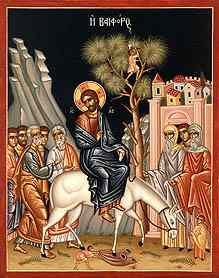
As they were reading the passion today, as we do on Palm Sunday, I almost had to laugh at myself.
It ended with the stone being closed over the tomb. I thought to myself, hey...finish the story.
Of course, that is what this week is about. Holy Week. Holy Week if there ever was one. The heart of the faith is remembered this week in loving fashion. But as far as the Resurrection, well, that comes later.
My knee jerk thought is a reminder: Move slowly. Never forget what proceeds the Resurrection. The great sacrifice. The greatest act of love in the history of salvation. Take time this week to notice that act of love. Let it be a call to perform acts of faith filled love for our fellow people. Let the cross always go before us, as it is with us in our hearts.
May our faith in our Lord. Our understanding of His love. And our knowledge of the triumph over death, be in our hearts this week. But let us remember the sacrifice and remember our brothers and sisters in the world who also make the greatest sacrifice for the love of Christ.
Move slowly. Love deeply. The Cross of the Savior is with us, leading toward the triumph over death.
Friday, April 07, 2006
Hamas Leader says that Jews Control American Christianity
So here is the link to the story (link).
I found the original post at Infidel Bloggers alliance
Here is a quote from the article:
United States churches are secretly run by Jews who converted to Christianity with the intention of controlling religious Americans including President Bush, a top Hamas member claims.
Ok, I'll just say here what I wrote as a comment when I saw the original post.
Wow. Just wow. I normally talk alot, but the pure grain stupid of that knocked the wind right out of me.
As long as they don't find out about the direct brain link that connects us all to the Yahweh-I super computer that is run by the moon people and keeps the loch ness monster out of the Senate...we'll be fine. As long as bigfoot can keep his mouth shut, we'll be safe.
I mean..wow. That is a special kind of crazy.
It reminds me of this, back in February (link).
I found the original post at Infidel Bloggers alliance
Here is a quote from the article:
United States churches are secretly run by Jews who converted to Christianity with the intention of controlling religious Americans including President Bush, a top Hamas member claims.
Ok, I'll just say here what I wrote as a comment when I saw the original post.
Wow. Just wow. I normally talk alot, but the pure grain stupid of that knocked the wind right out of me.
As long as they don't find out about the direct brain link that connects us all to the Yahweh-I super computer that is run by the moon people and keeps the loch ness monster out of the Senate...we'll be fine. As long as bigfoot can keep his mouth shut, we'll be safe.
I mean..wow. That is a special kind of crazy.
It reminds me of this, back in February (link).
Thursday, April 06, 2006
The words of a Turkish Woman about Fr. Santoro
This is a wonderful letter by a Turkish Christian explaining what the death of Fr. Santoro has done to the hearts of his flock. (link)
From the letter:
I was a teenager when this man first came among us 13 years ago.
Already then he was silent and meditative, spending hours in our small church in prayer. We young people – and I was not even a Christian at the time – would ask our parish priest in amazement why he spent those long intervals before the tabernacle. He would reply that the priest was asking the Lord to show him the way. There was the possibility he may come to Turkey. We made a party for him on his feast day and before he left for Rome, he told us, moved: “Insallah (God willing), we will meet again”.
I never saw him again save for now, dead, in many photos printed in the mass media.....
This land is soaked with the blood of St Ignatius of Antioch, of St Chrysostom, St Babila and others. Those were times of persecution and hate, and their icons in church tell us about them.
It is on their blood, and the blood of St Paul, who worked so much for the Gospel, that our Church in Turkey was founded and flourished.
We forget the role of these great Churches. Of the entire Middle East. Christianity has a birthplace. It has a home. And we, in the west, usually ignore that. The churches in the East knew each other, but they are all being persecuted. In the West we have focused on our differences, and not on helping the members of the One Body in Christ.
Then the Christian communities – as though they were no longer members of the same body of Christ – were forgotten by the West, busy on other fronts, and they fell into silence.
In 1846, the Catholic Church of Latin rite, that had never led Antioch out of its sight, returned to our city with the Capuchin Brothers. The first to arrive was the Italian, Fr Basilio Galli. Tireless, active, he won the sympathy of people; he opened a chapel and a small school. The plaque at the entrance of our church reminds us how he paid with his life for his zeal: he was martyred on 12 May 1851, stabbed in the back in church by two murderers, just after he celebrated morning Mass.
Very much like the death of Fr. Santoro. The murderer of Fr. Santoro had to walk past this plaque to kill his victim. The meaning of it, I am sure, never reached his heart.
They tell us that now the Christian community in Antioch is the most alive of all in Turkey, the most dynamic and open to dialogue and ecumenism.
What will become, then, of that of Trabzon, once flourishing and now reduced to the bare minimum?
Our parish priest explained to us that Fr Andrea is remembered as a person who committed himself to serving the poor, prostitutes and dispossessed people. In Italy, he was very involved in social work and had set up various structures to help needy people. We know well enough that one can do very little. You help someone when and how you can, but I don’t think it was this that gave meaning to Fr Andrea’s day.
Looking at our priests, our sisters, who left their entire world to come among us – but why do only so few decide and have the strength to stick it out here? – I ask myself how they manage to remain. Here there is dryness, inefficiency – by western standards – a poor life, without immediate successes: it is only faith that sustains and justifies such a presence.
Faith can bring us to do much beyond what we think we can. It perfects us. It calls us to the service of others.
His death has reawakened us from the torpor of our consciences; it is reminding us what it means to die for love. It has reminded us that a Christian can make himself an uncomfortable presence that must be removed, eliminated. And if this is not the case, then one is not a true disciple of Christ.
But after death, comes Life.
The Church of Turkey perhaps needed more of this.
Perhaps we needed more of this.
His death caused us heartbreak, but it gives a new strength, a new hope. It teaches us love. That Love for which I asked for baptism, going against the advice of my family.
We have a new protector and intercessor up there. He chose to take our side. The side of the innocent and defenceless. Without rebelling. Right until the end. For love of God and brothers. This is a marytr. This is the death that brings Life.
May God bring them hope. From this letter it is sure, that He is in their hearts. And may the Lord bring comfort to all those who suffer in the Middle East. And as we move toward Easter, may we all remember the martayrs of the great Christian churches of the Middle East, and in them may we remember the death that brings life.
From the letter:
I was a teenager when this man first came among us 13 years ago.
Already then he was silent and meditative, spending hours in our small church in prayer. We young people – and I was not even a Christian at the time – would ask our parish priest in amazement why he spent those long intervals before the tabernacle. He would reply that the priest was asking the Lord to show him the way. There was the possibility he may come to Turkey. We made a party for him on his feast day and before he left for Rome, he told us, moved: “Insallah (God willing), we will meet again”.
I never saw him again save for now, dead, in many photos printed in the mass media.....
This land is soaked with the blood of St Ignatius of Antioch, of St Chrysostom, St Babila and others. Those were times of persecution and hate, and their icons in church tell us about them.
It is on their blood, and the blood of St Paul, who worked so much for the Gospel, that our Church in Turkey was founded and flourished.
We forget the role of these great Churches. Of the entire Middle East. Christianity has a birthplace. It has a home. And we, in the west, usually ignore that. The churches in the East knew each other, but they are all being persecuted. In the West we have focused on our differences, and not on helping the members of the One Body in Christ.
Then the Christian communities – as though they were no longer members of the same body of Christ – were forgotten by the West, busy on other fronts, and they fell into silence.
In 1846, the Catholic Church of Latin rite, that had never led Antioch out of its sight, returned to our city with the Capuchin Brothers. The first to arrive was the Italian, Fr Basilio Galli. Tireless, active, he won the sympathy of people; he opened a chapel and a small school. The plaque at the entrance of our church reminds us how he paid with his life for his zeal: he was martyred on 12 May 1851, stabbed in the back in church by two murderers, just after he celebrated morning Mass.
Very much like the death of Fr. Santoro. The murderer of Fr. Santoro had to walk past this plaque to kill his victim. The meaning of it, I am sure, never reached his heart.
They tell us that now the Christian community in Antioch is the most alive of all in Turkey, the most dynamic and open to dialogue and ecumenism.
What will become, then, of that of Trabzon, once flourishing and now reduced to the bare minimum?
Our parish priest explained to us that Fr Andrea is remembered as a person who committed himself to serving the poor, prostitutes and dispossessed people. In Italy, he was very involved in social work and had set up various structures to help needy people. We know well enough that one can do very little. You help someone when and how you can, but I don’t think it was this that gave meaning to Fr Andrea’s day.
Looking at our priests, our sisters, who left their entire world to come among us – but why do only so few decide and have the strength to stick it out here? – I ask myself how they manage to remain. Here there is dryness, inefficiency – by western standards – a poor life, without immediate successes: it is only faith that sustains and justifies such a presence.
Faith can bring us to do much beyond what we think we can. It perfects us. It calls us to the service of others.
His death has reawakened us from the torpor of our consciences; it is reminding us what it means to die for love. It has reminded us that a Christian can make himself an uncomfortable presence that must be removed, eliminated. And if this is not the case, then one is not a true disciple of Christ.
But after death, comes Life.
The Church of Turkey perhaps needed more of this.
Perhaps we needed more of this.
His death caused us heartbreak, but it gives a new strength, a new hope. It teaches us love. That Love for which I asked for baptism, going against the advice of my family.
We have a new protector and intercessor up there. He chose to take our side. The side of the innocent and defenceless. Without rebelling. Right until the end. For love of God and brothers. This is a marytr. This is the death that brings Life.
May God bring them hope. From this letter it is sure, that He is in their hearts. And may the Lord bring comfort to all those who suffer in the Middle East. And as we move toward Easter, may we all remember the martayrs of the great Christian churches of the Middle East, and in them may we remember the death that brings life.
Subscribe to:
Posts (Atom)